
Top 10 FAQ of a Returned Peace Corps Volunteer
What better way to continuing wrapping up my Peace Corps journey than returning to a favorite type of blog post, a top 10 list. This time I'm going to run through the ten most common questions I get from people interested in my time in Ghana.
What was your greatest accomplishment?
Honestly, I’m just really proud that I lasted 26 months. I got sick a lot. Physically, it nearly destroyed me. I threw up regularly (I almost never threw up before Ghana), I tore my rhomboid muscle, I had an ear infection that resulted in the worst pain I’ve ever felt in my life and I struggled on a daily basis to get enough exercise and nutrients. This is all to say nothing of the loneliness, loss of anonymity, lack of productivity, and general frustration I felt constantly that wore me down mentally and emotionally. I served for the full term and that feels like a great accomplishment all by itself.
In terms of tangible accomplishments, the Cashew Hackathon comes to mind. I created it virtually from scratch and while I made some mistakes, it was successful enough to produce real products from the groups and the event was used as a blueprint for more Hackathons in Ghana and other Peace Corps countries including Morocco and Tanzania.
What was your biggest failure?
Not finding a way to be replaced feels like a lost opportunity. The people who lived in my community were all around amazing. They were kind and smart and open to new ideas. They did everything in their power to follow Peace Corps' instructions and worked with me when I was unhappy with something going on. Typically, each community gets three volunteers one after another unless Peace Corps has reason to believe it is not a good fit. I was the first volunteer at my site and I was adamant that I be replaced. But early on, I was informed that we were the only community requesting a volunteer who would need to learn the language Ewe, which didn't make sense from a logistical perspective. We needed to find another Ewe-speaking community to make the cost of hiring an Ewe teacher worth it. I relied on some of my community members to find a nearby community that was a good fit for Peace Corps but it never happened. I wish I had been more proactive and involved in this search because I think my input in those conversations would have been valuable. Without that added input, we didn't find another Ewe-speaking community and I left Ghana without someone to replace me.
Are you glad you did it? Would you do it again?
I’m definitely glad I did it. And while I understand it’s not a realistic option for everyone, I think more people should consider joining the Peace Corps (or something like it). That being said, while I found it tremendously valuable to do once, I probably wouldn’t do it again. I think there is a point of diminishing returns in what you have to offer and what you have to learn. That being said, I'd consider signing up many years from now for a situation different than the one I already experienced. Maybe if I was married and could work in the schools with my wife during retirement I'd apply again.
What was the biggest challenge?
I've talked about the loss of anonymity elsewhere but it's worth emphasizing. I've never sought out the spot light but I wouldn't say I've shied away from it either, so I was surprised with how much I struggled with this. Some elements were definitely cultural and personal. It's unusual in American culture to constantly be social outside of the house, including and especially with people you've never met before. Plus, I'm introverted and tend to be quieter in bigger groups. These things immediately worked against me but I don't think either was the reason it challenged me as much as it did.
Upon reflection, I realized that a big component to my frustration with the attention I received was why I was getting it. I was popular and in the spotlight because I was white and American, neither of which I was responsible for. I wasn't being asked to sit in front church because my contributions to the community merited that status. I wasn't asked to give speeches at funerals and weddings because my ideas were worthy of special consideration. I wasn't asked for money or food or to be someones friend because I had a reputation of being a considerate and reliable individual. I wanted to be just a normal member of the community, treated just as any other community member would be treated. But the special attention happened day in and day out because I was perceived as being of high value due to things that had nothing to do with my character. To be fair, in at least some circumstances it was meant to make me feel at home and wanted. In other other cases, I welcomed the extra privilege as a means to get through the day or to move projects forward. But in all instances, it distanced me from feeling like a true part of the community and served as a reminder that I was perceived as different.
Tell me a crazy story!
The Fire Festival in northern Ghana is definitely something I will never forget. I'm not sure I could put into words how "crazy" it was but I will do my best.
The historical meaning of the festival goes like this (the specifics of the tale are told differently by different community members so this is a general outline of what they say happened): Hundreds of years ago there was a chief of the Dagbani tribe (located in northern Ghana) who lost his son. All of the men who lived in the community where the chief resided lit torches and went to look for the lost boy. After hours of searching, they found him sleeping under a shea tree and returned him to his father. The Chief deemed the shea tree to have evil powers and ordered that the tree be destroyed. Every year since, on the anniversary of the disappearance of the boy and the evil tree being destroyed, the expedition for and recovery of the Chief's son is recreated in hundreds, if not thousands, of Dagbani communities.
My personal experience of the fire festival occurred in a community where Connor, a Peace Corps Volunteer, was living. About ten of us went to participate and I'm not sure any of us knew what to expect. Even the story I just told about the Chief and his son was unknown to us beforehand. All I knew was that other volunteers insisted it was worth traveling two and a half days there and two and a half days back in order to participate.
The night of the festival we met two of Connor's counterparts in the center of the village and I was immediately struck that there were no other adults around. Weird. There were, however, about 100 kids aged 2-13 all around us. One of them, under the mentorship of the counterparts, was selling fireworks to the other kids. At first the fireworks would be lit as all of the kids crowded 2-3 feet away watching them go off. This slowly devolved and within 10 minutes the kids started lighting the fireworks and throwing them at each other. A few went off just a couple feet from where we were sitting. Some of the volunteers in our group were scared and disturbed by this, others unhappy but reticent to influence a culture that was not ours, and others just went with it. I had no idea what to do so I stood next to the box of fireworks as they got sold and tried to convince the kids not to throw them at their friends (to no avail). This went on for about an hour and fortunately, as far as I could tell, no one was seriously injured.

Around the time when the fireworks ran out, we were instructed to quickly stand up, grab a pre-wrapped bundle of dried grass about 6 feet tall and told to get ready. Ummm, okay. Ready for what? At that moment, I started to hear drumming and chanting behind me so I turned around and saw painted in the black of night about 100 flames in the distance. And every few seconds another 20-30 flames would emerge from around the corner of the bend in the road as the sounds got louder and louder. The counterpart, who moments ago was laughing as children evaded fireworks going off inches from their feet, was suddenly very serious and instructing us to get out of the road and to stay alert. We worked to light our torches and watched as hundreds of village members painted in white chalk marched past us, rifles and cutlesses (machetes) in hand, chanting, drumming and mock fighting with each other. Each had a "torch" (dried bundle of tall grass) and were waving it threateningly in the air (I learned later that this is actually to provide the flames with oxygen to keep the torch burning strong). The heat from the fire was intense and the demonstrations from the villagers was startling.
I had been in Ghana almost two full years and I was in shock. I had no idea what to do or how to process what I was seeing. Not to say I was anything but thrilled. The energy was palpable but we had no idea what to do and recognized it could be an dangerous situation if we made a mistake. One of the counterparts ushered us to the back of the "parade" that now must have numbered at least 500 people on a road about 5 meters wide. Another 500, mostly women, stood on the sides of the road and watched. The counterparts positioned us behind most of the torches, but now the smoke trail was in our face and was disorientating. The counterparts made it very clear we needed to follow their instructions and follow their guidance, a directive I would learn later was extremely important.
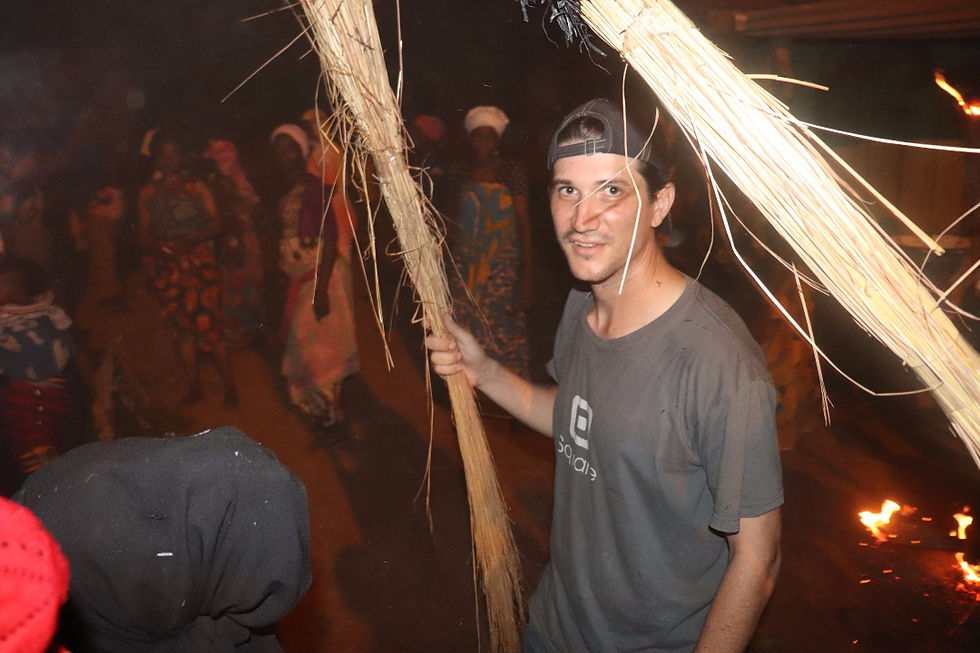
At this point we started to feel more comfortable started enjoying ourselves. That lasted about a minute before my wrist was grabbed and my body was pulled into the crowd in front of us. Before I knew it I was surrounded by flames and one of the counterparts was looking at me with a big grin on his face. I did my best to march and chant along with the crowd and integrate but it was so intense and there were so much going on. Keep in mind, it's the middle of the night and we're walking on a road that is neither paved nor flat and is littered with pot holes and rocks. The fire could only light the ground so much and the crowd was so dense that you couldn't see the next step in front of you anyway. This would have been a challenging if it was a normal parade, but every time you tripped or stumbled, your torch ended up in somebody's face and a domino effect rippled throughout the crowd. It felt like torches were flying everywhere. So I'm trying to walk and chant while at the same time keeping my balance and avoiding unpredictable moving torches. More than once I hit someone directly with fire and a few times only barely avoided being hit in the face with flames myself. For a moment I took my shirt off. Most of the men were marching this way already and I was worried about my shirt being accidentally lit on fire. But the counterpart immediately made me put it back on while pointing out all of the ash that was accumulating on it and telling me my skin wasn't ready for the burns of the embers. Because here's the thing: it was grass that was burning, not an actual torch, so the top of the grass, still very much on fire, would come flying off every time you shook it, on purpose or otherwise. Meanwhile, the men with guns started firing them in the air. They were black powder rifles and these things were LOUD! In fact, they were so startling when fired that they often would pretend to fire them next to you just to freak you out.
After 5 of the longest, scariest and most exciting minutes of my life, the counterpart disappeared to grab another volunteer and bring them into the crowd. Now alone, I found my way to the side of the road and waited to rejoin my friends at the back of the group. The spectators walking on the outside motioned to see if I was okay, which was comforting and I was happy to give a thumbs up. However, before I could find my friends, some local kids decided I hadn't had enough fun yet. Two boys, probably around 12 or 13 years old, took my hand and dragged me back in. These kids were clearly not first timers because they knew exactly where to take me to keep me safe, comfortable and having fun. Between the size of the crowd, the smoke and the ash, it became increasingly difficult to keep my eye on the other volunteers and counterparts so I put my trust in these kids. Fortunately, they were absolutely incredible. We had so much fun interacting with people and if I ever felt uneasy, they quickly led me to a less dense area of the crowd. These little guys were seriously amazing and I will remember their help that night for the rest of my life.

About 30-40 minutes after we joined the march, it was time to light the tree and "rescue the Chief's son." For whatever reason, most of the volunteers, including myself, retreated from the crowd and watched. It was around this time that one of the riflemen decided to have some fun by pointing his gun at me and chasing me around. I tried to act "cool" and "in on it." I knew on some level he was just playing and since it was a Muslim majority community, I knew he was sober. So I went right up to him, grabbed the barrel of the gun, put it against my head and told him to pull the trigger.
Just kidding. I mostly "played along" by hiding behind other people pretending not to be on the verge of peeing myself.
Anyway, after 15 minutes at the tree, the torches were finished and the parade was on it's way back. Shea tree leaves and fireworks replaced the torches for most people, while others held mock fights with their cutlesses or fired their rifles some more. Mostly, the journey back was much less intense and stressful, although equally loud. We marched all the way to the local Chief's palace to gather for a quick blessing in which he sprayed everyone with water. As I understand it, this was meant to symbolically purify the shea tree branches we held in order to rid the tree of evil spirits and keep it from enchanting more young children.


About 1.5-2 hours after the festival started, it finally started to die down and the volunteers and counterparts retreated to our initial meeting place to regroup and take the picture above. If I look a little shell shocked in the photo, you can probably understand why. The next day we returned to the regional capital, Tamale, where I ran into a Dutch friend of mine at a local spot (a Ghanaian term for a bar). He showed me pictures and videos of the experience he had in a different Dagbani village that utilized a literal cannon. Sadly, my Dutch friend said that someone, a local, died during the festivities after he was mistakenly shot by a rifle. It was a sobering reminder of just how serious the situation we were in was and how thankful I am that I had such amazing counterparts making sure we were safe and a community that was extremely welcoming to 10 foreigners.
As Ghana continues to develop and cultures merge with the rest of the world, I'm left wondering what will happen to the fire festival and what that means for broader questions about life and culture. Will the fire festival continue in the same way I experienced it? Should it continue that way? Are unsafe aspects of a culture worth abandoning even if everyone participating in those rituals are aware of the risks? Should we reconsider how we have dealt with similar instances in our own culture? I'm not sure I know the answer to these questions but the fire festival has definitely opened me up to a wider possibility of answers while providing me with a "crazy story" that will leave a lifelong impression on me. I'm not sure how I feel about future fire festivals but I know that I loved the night I got to participate in one.
What do you regret?
In addition to not being more proactive finding nearby communities for Peace Corps volunteers (see above: biggest failure), I regret not burying myself in the schools and working more consistently with the kids in my community. The two 4H clubs I started provided the most personal fulfillment out of all my projects and being around those kids made me happy. Plus, because the kids were at an age when their thoughts, attitudes and personalities were still developing, that work probably had the greatest impact for the time and energy spent on it.
I also regret not making my bedroom into something that felt more personal. I never hung pictures or decorated, and I think small touches like that would have gone a long way into making me feel more comfortable while at home.
Finally, I regret not making regular Vlogs. Sometimes writing was cumbersome and tiring. Knowing that what I wrote needed to be creative and concise and entertaining and well edited made each post really time consuming and difficult to convey emotion. I think even just 5 minute videos filmed once a week would have not only made things more real for my friends and family at home, but given me a cool time capsule to look back on years from now. I'm glad to have this blog and some videos I made during my service, but a week by week outlook would have been more encompassing I think.
Was it hard leaving Ghana and returning home?
The last week in my community was hard – I cried a few times and it was emotional. But once I left, I was able to put it behind me and focus on the next chapter of my life pretty quickly. Ultimately, I had been ready to come home for a while and I was really happy to take the next steps in my life. I had some small challenges reintegrating back into western culture but I wouldn’t say it was particularly difficult and certainly not as bad as what a lot of other volunteers experienced.
What was the most important thing you learned?
I learned one important thing about the world and one important thing about myself.
Regarding what I learned about the world: the key issues developing societies are struggling to solve are complex and these complex problems have complex solutions. In the west we are used to having answers to everything and products/services to fill every need. If you have enough money and time, anything is possible. Bringing that attitude to Ghana will result in nothing but frustration because that’s just not how it works in Ghana. The problems they have aren’t like ours. They are rooted in generations of historical context and crisis. Each problem has an infinite number of factors impacting it and an infinite number of unpredictable events ready to alter any solution.

For example, my community lacked a cash crop so I decided to introduce moringa trees to fill that need. Moringa already grows naturally in that area, moringa grows fast so we should see a comparatively quick financial return, there is an existing market for the seeds, and the leaves are extremely nutritious as a secondary benefit. It seemed like an obvious, lucrative and straight forward solution to a major problem. Plant trees on a farm, harvest seeds, sell the seeds and then teach others what we did. But only a few farmers were initially interested and the first seeds didn’t germinate, costing us more than a month. The next round of seeds germinated but many were destroyed by a brush fire costing us another month. We got a third round of seeds but at this point we had already missed the rainy season. Not to mention our resource for training flaked and never came. We also had an issue properly maintaining the farm because the farmers needed all their energy for their sustenance farming. I could do more of the manual labor but that only increases the reliance on foreigners, and nothing would be learned and retained by the local farmers if I was doing it by myself. The following rainy season was a poor one and the trees didn’t get enough rain to produce seeds. More than a year after this project began, we had very little to show for it and we were still years away from it becoming the future cash crop for the farmers in my community.
Regarding what I learned about myself, I realized that it’s much healthier to accept who I am and to forgive myself for my shortcomings. When I first arrived in country, I had an image of who I would be that had been manifested by reading about inspiring people and stories. But on most days, I fell far short of that ideal and it really got me down early on in my service. But if I had let it keep me down, I never would have made it twenty-six months. I had to learn to accept what I am not as to be thankful for what I am. I think that would have taken a lot longer had I not been a PCV.
What were your best and worst days?
I'm not sure any one day stands out as the best, but the top ones usually involved doing something new and different. The first day at home stay, the day mushrooms started sprouting in our cultivation center, the hike of wli falls, the first day I got to explore the capital on my own, and the presentations day of the Cashew Hackathon were all special in their own way.
The worst day wasn't an obvious one. It wasn't the day of the 2016 election, the day I joined "the club" or the day that my backpack was stolen (with my laptop, kindle, phone, passport and about $100 cash inside). It was without a doubt the day I joined a group WhatsApp comprised of volunteers who wanted to have thoughtful discussions about various diplomatic and societal issues. Instead, it almost immediately devolved into an argument that I don't wish to share here. But suffice to say, I wasn't happy with how I was treated by fellow volunteers and given the other stresses of Peace Corps life, I was left upset for days afterwards. While it was difficult at the time, I learned from it and for that reason, I'm actually glad it happened. It was just a very challenging day at the time.
What can I do to contribute?
I talk a little about my answer to this question in the second half of this post. Consider how much money you could save by making small changes to your lifestyle and then consider donating that money to worthwhile causes abroad. We're exceptionally lucky to live in the United States and to have the opportunities afforded to us by that good fortune. I'm always so happy to see how generous many Americans are towards those less fortunate and I hope this sense of giving continues to increase and starts to specifically target those in the world who could benefit the most from such kindness.
Comments