
The Work - An Update (Part 2): No Till, Moringa & the Permagarden
This is part 2 of my November, 2017 work update. To see part 1, click here. To see my first blog post about the work I'm doing written in June, 2017, click here.
No Till Agriculture: No till agriculture can be so effective because it focuses on maintaining soil health to create better yields for crops. It teaches farmers not to plow or disturb the soil to keep the ecosystem with beneficial microbes intact and to avoid a hardpan forming where the plow/hoe doesn’t reach. It also preaches the benefits of cover crops, which has many benefits for the farm. First, they provide nitrogen and other nutrients to the soil and most cash crops (maize, cassava, plantain, etc.) need nitrogen to grow strong. Next, they serve as excellent mulch because they effectively protect the soil (and moisture within it) from the blazing hot African sun. Finally, they assist with the maintenance of the farm because they grow thick and keep the weeds from sprouting. Effective no till farming also requires proper plant spacing to ensure plants have enough room to grow but aren’t so far apart as to waste space.
By the time of my first post work related post we had created two no till demonstration plots, the second of which had six different cover crops and was meant as a seed bank. I’m happy to say that the execution of maintaining the land and harvesting the seeds went flawlessly. I continued to receive support from the school/church that helped me setup the second plot and we now have a bucket of seeds for each of the different crops, save one that takes longer to mature.
After harvesting, I discussed next steps with my counterpart Peter. Our plan was to spray weedicide (which I subsequently bought) on the full plot because the places that we didn’t grow cover crops had weeds and we wanted to progress into using the full land. Then they were going to call me so we could sow maize and intercrop with one or more of the cover crops during the minor rainy season with proper spacing techniques. However, Peter hurt his foot and was confined to his house for a week or so while this was supposed to happen. Unfortunately, signals got crossed. They didn’t spray - instead they tilled the land with a hoe and planted the maize with no spacing method at all, using multiple seeds per hole (another common mistake). This ruined most of the work we had put in to fixing the health of the soil and we have to start over again. Worse, it made me feel a little helpless because it became clear to me that my lessons hadn’t made as much of an impact as I had hoped. Maybe it was a bit too optimistic but I thought they would have known not to till the land even if I hadn’t been personally directing the workers.
There are some silver linings though. First, it’s an important learning moment for me. Now I know that my lessons and demonstrations need to be clearer and I need to repeat some of the key points as many times as I can to get them to stick. Also, because one of the cover crops hadn’t matured, they didn’t touch it and it serves as a comparison between what they’ve done with the rest of the land. Two weeks after they tilled the land, weeds were sprouting up everywhere except in the area of the cover crop. Plus, when you feel the soil under the cover crop, it’s cool and moist compared with the soil around it, even weeks after the last rain. Finally, because of the mix up, Peter and the school/church have felt bad about what happened so they found another plot for us to plant another seed bank. The land is located at the entrance to the community so it will be highly visible example of what no till can do for the soil and our yields. We planted four cover crops there with the 4H club last week and I will plant two more myself this week.
Of course, behavior change is our ultimate goal and for that reason, we brought in experts to give a lectures and demonstration in my community. Another PCV, Sarah, works at the Center for No Till Agriculture (CNTA) in Ghana and came last May to assist with our first two no till plots. This time, she came with one of the heads of the CNTA, a Ghanaian, to teach more farmers in my community. It’s especially valuable having the farmers hear these things from a Ghanaian.
I’ve also been able to take what I’ve learned from Sarah and my time at the CNTA and give lectures and demonstrations on no till practices myself. Normally these are impromptu meetings and conversations with farmers around my community. But recently, I was invited to a PCV’s site near my own to teach some farmers in her area interested in these improved practices. I gave a quick lecture and then we went to farm and setup a no till plot with five different cover crops. The farmers were really engaged and I have high hopes for what they’ll be able to accomplish with the assistance of their PCV.
Moringa Farm: Torgbui is my counterpart on the moringa farm, which is the newest of my ventures at site. A couple of months ago, we decided to focus our efforts in this direction for a few reasons. The primary reason, as I see it is that our area lacks a true cash crop. My community grows maize and cassava almost exclusively, with cow pea and other legumes thrown in occasionally. All of these are labor intensive to maintain properly on a large scale, risky from season to season because of unpredictable weather, potentially expensive (eg. Fertilizer, pesticide, etc.) and even in the best cases, are not that profitable. We hope moringa will solve these issues and provide a crop that our local farmers can both rely on and profit from.


My community did try moringa 10 years ago but apparently there was no market. While I don’t know the details of what happened 10 years ago, this time around I worked with a PCV with moringa experience to find an NGO, Moringa Connect, who will buy seeds in our area. Before I told all of the farmers in my area to start growing moringa, I wanted to have at least one positive experience working with Moringa Connect and visualize how much money we can make on a single acre. While they prefer to buy in bulk, Moringa Connect has been understanding of our hesitation and are open to an initial proof of concept farm.

Over a month ago, Torgbui sprayed the whole farm with weedicide (badly hurting his back and legs in the process) and we paid for some farmers to hoe the land to kill the weeds. While using a hoe is less than ideal, we are and will continue to utilize the principles of t till agriculture on this farm. About three weeks ago, we planted 214 moringa seeds and exactly 6 germinated (and 3 subsequently died). As it turns out, the seeds given to me by Peace Corps aren’t great or have since spoiled. In response, we are trying to nurse the Peace Corps ones to see if we can produce a higher germination rate and we’ve also received some free seeds from Moringa Connect to test.
Admittedly, even though moringa is draught tolerant, starting this farm at the end of the minor rainy season (dry season begins in late November and lasts about 4-5 months) was risky to begin with. That’s what happens when you only have two years to start and complete projects.

Nutrition Focused Permagarden: It’s almost funny to me looking back at my first work post that the permagarden was the first work item listed. Not that there is a particular order for the items on either of these lists, but it was definitely my primary focus a few months ago before I had started 4H clubs, before I had a mushroom grant approved, and before we were starting moringa and no till farms. However, for right now my permagarden is very much on the back burner. And while I still hope to continue it and have it ready for the major rainy season, which starts in April/May, I’d like to spend this time talking about how and why this project has failed (so far).
First, I lacked a true counterpart who had the same vision for the garden as I did. In my first post I said, “My strategy has been to work on it entirely myself in my spare time hoping that the results will by my best selling point. If even I – a foreigner – can make a nutritious garden by myself with no added money, surely the villagers with a full family of laborers can do it.” My intention here was good, but it simply became too much work for me to do by myself as a completely inexperienced gardener/farmer. I need at least one other person – ideally a group of people - who believe in the purpose of the project as much as I do. They can provide labor when I’m too busy or tired, water the plants when I’m out of town, and advise me regarding farming related things like how much water different crops need.

Speaking of the nursery, I’ve now had two of them fail. And if I can’t get the nursery right, then I’ll never have plants to grow in the garden. The nurseries have failed in part because most of the seeds were likely spoiled by the time I used them. I received free seeds from the Peace Corps and had more sent to me from home – only one of the 7 seeds I sowed germinated well (the tomato) in both of the nurseries. The first nursery was dug into the soil and amended with charcoal, ash and chicken manure, protected by a fence and covered with a net. The second was made with the same soil, but placed in used water sachet bags.
My last major problem was the location and size of the garden itself, which I initially thought was perfect because it was situated next to a roof, which I thought would drop more water in the direction of the garden. However, the slope of the land is actually towards the house instead of away from it. So the rain from the room doesn’t actually naturally enter the garden. I also made the garden to big. When I started the garden, it was all I had to work on, so I made the boundaries large, figuring I’d have plenty of time to work on it. I still have not dug enough beds to fit the entire boundary and even then there is still 10-15 feet between the edge of the garden and the road where weeds can grow and block the view from people walking by (which for now is probably a good thing).
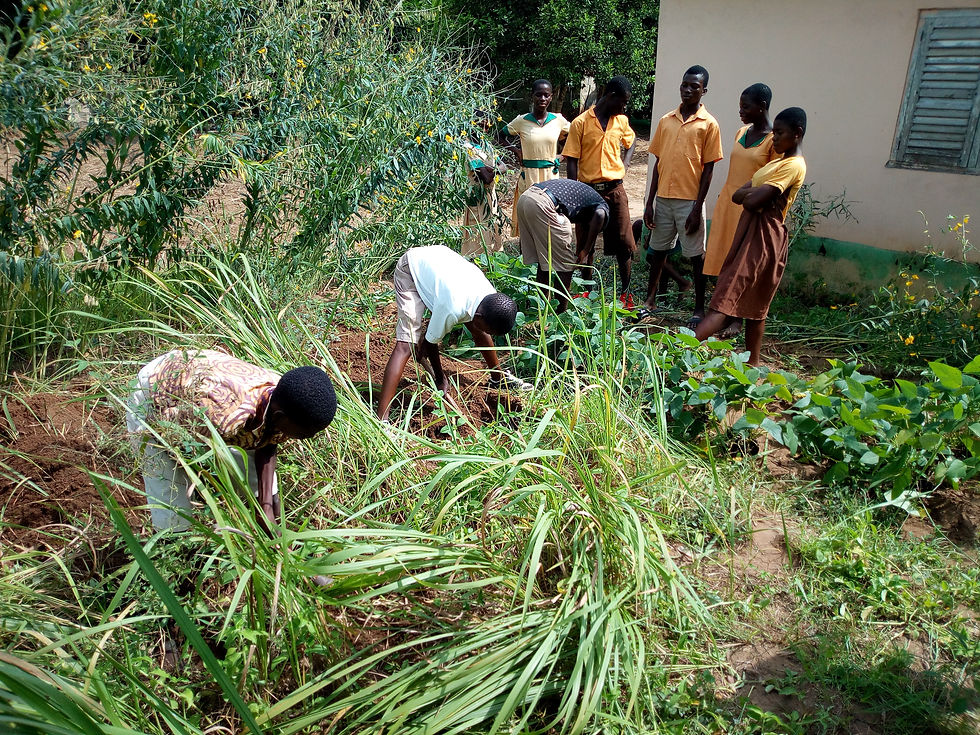
For now, I’ve had one of my 4H clubs working on it slowly, mostly as a demonstration and learning tool for them. Ultimately, I hope to recruit a few people interested in its success so we can have something ready for the major rainy season this spring.
Comments