
"Learning is an experience. Everything else is just information" - Albert Einstein
When I signed up for the Peace Corps I was cautiously optimistic about my chances to successfully integrate and adapt to my surroundings. While still vastly underdeveloped in many ways, Ghana has managed to cultivate a (reasonably) safe and healthy environment.
But I was undoubtedly nervous – you just never know. There’s no mistaking that Ghana is, if nothing else, a vastly different country than the U.S. with enough cultural quirks to make Bollywood seem indistinguishable from a Quintin Tarantino movie by comparison. Plus, even if I was going to be okay, there would likely be people in my cohort that wouldn’t be able to cope as easily. There’s one member of my cohort that could count the number of times he had left his home state of Oregon on one hand and had never even left the west coast!

Safe to say, the Peace Corps Ghana staff had a very tall task. They were given 10 weeks to prepare a large group of people who have a variety of travel experience, development experience, technical knowledge and learning styles to live on our own for 2 years in a place that to us might as well be another planet. They had to teach us how to keep ourselves safe, all the Peace Corps policies, how to communicate in a language we’ve never even heard of (let alone know anything about), all the cultural differences and, oh yeah, the actual reason we’re here – the local agricultural knowledge that we need to know more about than our community members whose family have been farmers for generations upon generations. Have I mentioned that I hadn’t been on a farm since I was 8?
After nearly two months of training I can report that I (and my friend from Oregon) have integrated more fluidly and learned more than I ever thought possible in this time span and I give all the credit for the transition to the amazing Peace Corps Ghana staff. Made up mostly of Ghanaian nationals, the staff is large and the culture is such that the janitors and drivers are as loved and well-respected as the country director. They’re organized, prepared and most importantly it’s evident to me that they care deeply about the work they’re doing. If this had taken place stateside they would be worthy of high praise, but to train us like they have in a place where resources are scarce, adequate facilities are hard to find and local people are, well … unreliable, their execution is truly impressive. Perhaps it’s because the very first Peace Corps volunteers served in Ghana and service has never been broken in over 55 years, but they have transitioned us to our new home seamlessly.
When we arrived in the airport, what felt like 40 people (and may well have been 40 people upon reflection) were there to help us get our things into the Peace Corps bus. My travel instincts were so accustomed to flatly ignoring people that try to help at airports that I accidentally insulted a few Peace Corps employees who were genuinely trying to help me. Once on the bus, we were given really nice Ghanaian sweets and juice and drove (with a police motorcade) to our first training site, a quiet college campus.
I’ll always remember that drive – the atmosphere on the bus was surprisingly jovial. We were tired from a long flight and had some nervous anxiety manifesting itself as laughter. The air conditioning was, even then, an unexpected luxury and the snacks were delicious. But as soon as you crossed the glass of the bus windows, the environment was completely different and entirely unfamiliar. Shops that looked like they were barely standing with owners sweeping dirt exterior in front of them. Buildings that reminded me of what I saw in war movies when

buildings had been bombed out. Streets and alleyways littered with trash. The roads in Accra were extremely busy with traffic and people walking around everywhere selling food that they carried around on their heads. None of them seemed at all distressed by the conditions that struck me as more challenging than anything I had ever experienced.
When we got to the college campus, we didn’t leave for nearly 5 days. They had a cooking staff for us that mixed American food with Ghanaian food to help us get acclimated and keep us full if we weren’t able to process the Ghanaian food yet. Our first venture into Ghana was done in groups with specific objectives to get us out and back quickly and safely but also just enough time to give us a taste of the culture we had been learning about. Then we went to our homestay community, the daily activities of which I wrote about on my last blog. Our homestay parents had been trained by the Peace Corps staff to sanitize food and cook to American standards. So while the meals were genuinely Ghanaian, they offered us a chance to ease into our new diet.
Every Thursday, we would go to a nearby training office for the day and learn about Peace Corps policies, safety and security protocols and more about what our roles would be as volunteers. We were given snacks in between the sessions and a buffet lunch with many options to make sure we could fill up there if we had been struggling with the food at homestay. To be honest, most of these sessions were a complete waste of time and a near exact repetition of a session we’ve already done. They spent way too long giving us information most of us learned in Junior High. However, I’m sure most of these sessions came as mandates from PC Headquarters in Washington D.C. and staff and volunteers alike did their best to get through them.
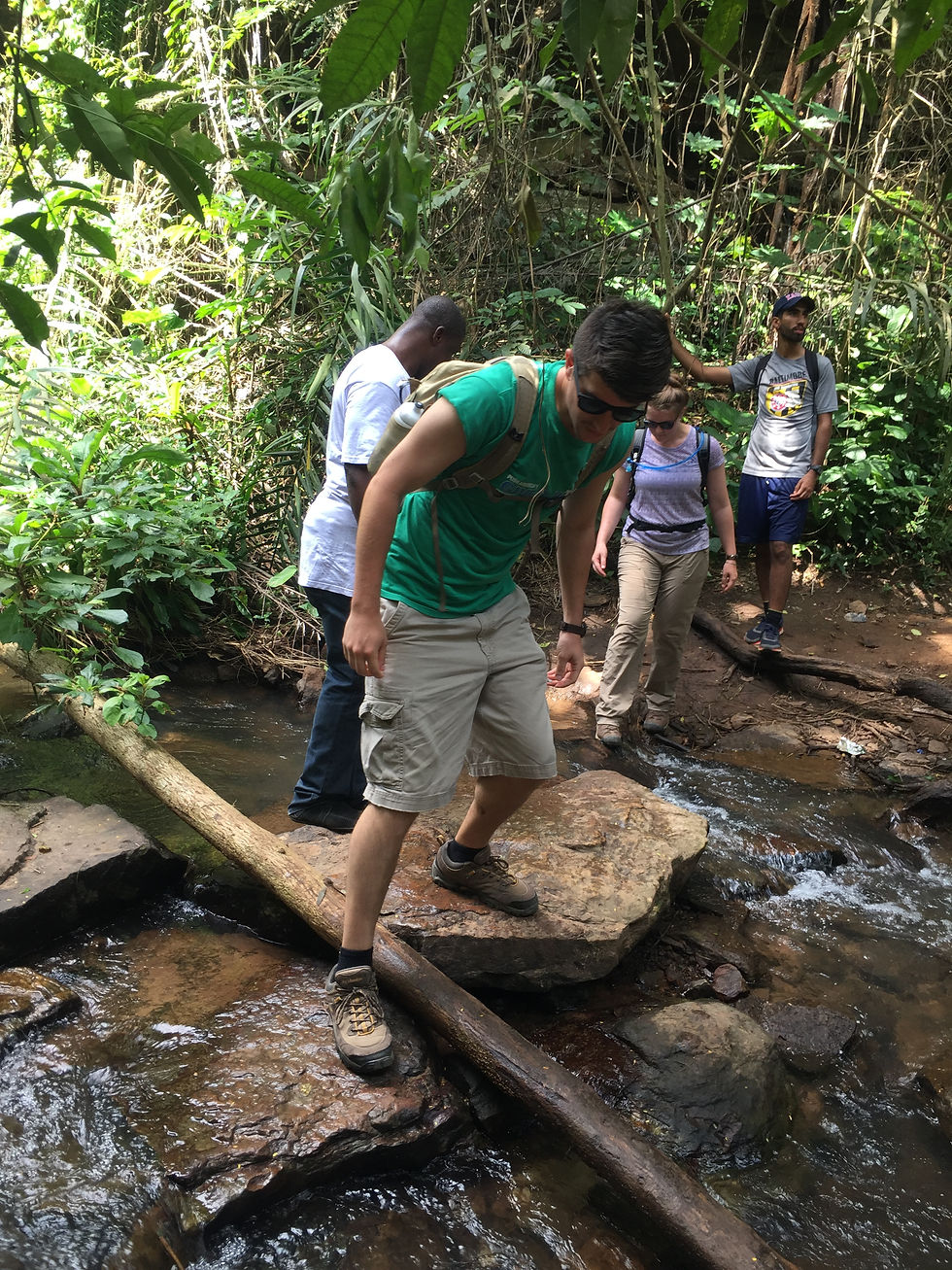
Finally comes site announcement and site visit. The term “site” is another name for the village/town you're assigned to as a volunteer. I plan to talk more about that in my next blog but just in case you think based on this blog post that I’m required to talk positively about the Peace Corps and my experience, site placement is my one big area of criticism I have of the Peace Corps so far and I will talk about that more next time. I’ve also already addressed this with the staff here individually and they were very receptive to my comments. And despite my feedback about how they handle this process, my community is amazing and I’m really excited to get started. Again, more to come in the next blog or two…
After site, we go to “Off-site Technical Training”, which is a week and half of Agriculture focused sessions in the field and in the classroom. This is perfectly timed since we just learned about what our community farms and what their problems are so we can ask pointed questions during these sessions that will be most relevant to us and our service. As of this writing, I’m not quite half way through this section of PST.
After this, we will head back to homestay for another week and half to finish some group projects that we’ve been working on before being sworn in and heading to site for good.
We received the day off today and as I walked around town to try and find the internet café, it occurred to me how normal everything felt and the initial shock I felt looking out the window on my air conditioned bus was a distant memory. I took a second to look around at the tattered buildings, the women running around with massive piles of food on their head, the motorbikes that don’t care that I’m an Obroni as they zoom by about 3 inches from my body. And it really hit home how well the Peace Corps did in acclimating me to this environment. As much as one can survive and even thrive in this environment, I've been given every opportunity to do so. At this stage, I'm just soaking in as much technical information as I can in hopes that I have something to offer a community who so badly needs my help.
Comments